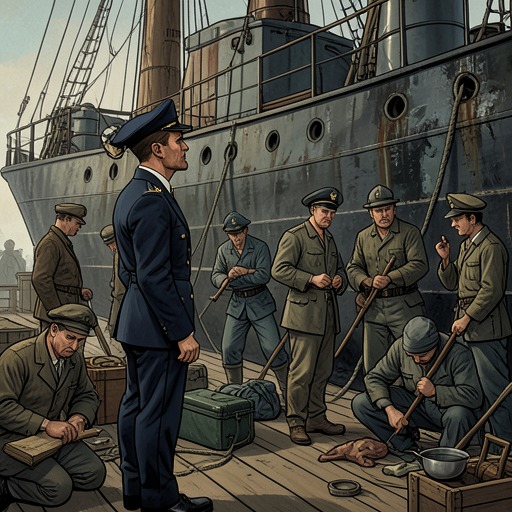
Tom Ellis
The Good ShepherdTom Ellis is Keeling’s sonar operator at a moment when a submarine’s presence must be inferred from sound and a single inexperienced rating’s interpretation may shape the ship’s response. The narrative introduces him not as a proven specialist but as an uncertain human link in a high-stakes chain of detection: his training has been brief, his practical experience with enemy contacts nonexistent, and his performance cannot be known in advance. When contact comes, however, he reports it in stages, and Krause later tells him that he has been a big help.
Identity and Background
Ellis is a Radioman First Class who has served aboard Keeling since the outbreak of war. He graduated from the Key West Sound School, where his preparation consisted of hurried exercises: listening to echoes from a friendly submarine, noting how pitch changed when it altered course underwater, taking bearings and estimating range, and receiving a few lessons on enemy countermeasures. After that short course, he went to sea to listen for echoes.
The crucial gap in his preparation is practical experience. In all the months since leaving the school, the signals he sent into the water had never returned from a submarine, friendly or hostile. He had never played the “deadly game of hide and seek” with an enemy. The narrative therefore distinguishes technical instruction from practiced judgment: even if Ellis once learned what an echo could mean, he may not recognize one now or draw the rapid conclusions needed for an effective attack.
Skill Under Pressure
When Keeling begins searching, the sonar’s repeated pings make the unseen water audible to the people waiting in the pilothouse. The equipment does not itself settle whether an enemy is there; the ship needs an operator to identify an echo and convert it into a useful report. Ellis is below, at the point where the information is first heard, while the captain and bridge crew wait for the talker’s relayed words.
The stakes make his competence impossible to separate from the conditions under which he must work. A depth charge dropped within ten yards of a target might mean victory, whereas one that misses by twenty yards means failure. The difference may lie in the speed and precision with which an operator recognizes and interprets an echo. The text also refuses to equate nerves with courage: a man might become confused simply because accurate manipulation and quick thought matter so much. Ellis’s ability cannot be confidently inferred from his record, and Krause has spoken with him personally only about a dozen times, in inspections and brief interviews. Those encounters revealed little about the young seaman who now stands among the men at quarters, carrying responsibility that his captain cannot assess from familiarity alone.
Contact and Reports
The first report is that sonar has made contact. The talker then gives its bearing as zero-nine-one, with the range indefinite. Krause does not question Ellis or press him for more. The narration explains that such questioning might unsettle him; instead, Ellis is to be presumed to know what is required unless evidence shows otherwise. His initial report marks a first test, and the bearing gives the bridge a concrete indication even though the range remains unknown.
A later report places the contact dead ahead at a range of two thousand. This is a meaningful change from indefinite range to a specific distance, while the contact’s bearing brings the submarine directly into the ship’s line of approach. Ellis’s information reaches the bridge in clipped, standardized reports through the talker. The restraint of the exchange matters: the bridge needs usable information, but the people waiting for it must not add pressure that could interfere with the operator’s work. In a scene dominated by uncertainty, the reports give Krause successive points on which to act without turning Ellis’s brief training into certainty about what he can do next.
Krause’s Trust and the Aftermath
After the submarine has been destroyed, sonar continues to report no contact. Krause orders that negative reports should stop unless fresh contact is made, then speaks to Ellis himself. He asks whether Ellis heard that they got the submarine. Ellis confirms that he did. Krause tells him, “You’ve been a big help. I’m glad I can depend on you.” Ellis replies, “Thank you, sir,” and is told that he can discontinue the negative reports.
The exchange changes the terms of Ellis’s introduction. Earlier, his ability existed chiefly as an unanswered question: training might have faded, and a real contact might expose hesitation or inaccuracy. Now Krause’s direct acknowledgment establishes that he has contributed to the ship’s work. It is not an account of the precise part Ellis played in the destruction, nor does the text provide a later career for him; its significance is the captain’s explicit recognition of reliance. The order to stop routine negative reports also closes the immediate reporting sequence, replacing repeated absence of contact with a conditional instruction to speak again only if something new appears.
Narrative Role
Ellis embodies the difference between equipment and operational knowledge. Keeling has sonar, but its value depends on a person who can hear and interpret what the instrument returns. His situation is set against the ship’s larger burden of sustaining attention: battle stations exhaust the crew, and watch routines must preserve readiness without consuming the men’s capacity. In that system, the sonar operator’s task is both specialized and consequential, even though his work remains largely invisible to those on the bridge.
The narration first makes Ellis vulnerable by emphasizing how little can be known about his nerve or current skill; only after his reports arrive does that uncertainty give way to evidence of competent performance and Krause’s confidence. His brief post-action conversation supplies a human acknowledgment after the tense, impersonal relay of bearings and ranges. Ellis does not become a fully developed figure with an independent arc, but his passage from uncertain operator to someone the captain says he can depend on gives the encounter a precise measure of trust earned under pressure.